Martian hounds
A Princess of MarsMartian hounds are formidable, intelligent animals whose role in Barsoomian life extends from hunting and war to personal protection. John Carter first encounters one as a guard placed outside his captive chamber; it soon proves not merely an assigned watchdog but a steadfast companion that follows him, saves his life, and returns to him across the wasteland. Its loyalty also becomes a measure of the difference between care as a relationship and animals as resources to be controlled.
Appearance and Uses
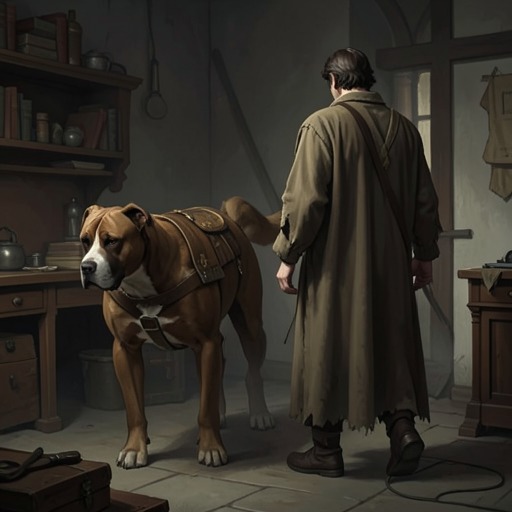
Carter’s first sight of a Martian hound comes when Sola summons it into the chamber. It is about the size of a Shetland pony, moves on ten short legs, and has a head likened to a frog’s, with three rows of long, sharp tusks. Its appearance initially gives Carter reason to fear what it might do when left beside him. Instead, it crosses to the chamber’s only street exit and lies across the threshold, guarding the door.
The hound’s compact-looking legs conceal exceptional speed. When Carter tries to leave the city, the animal blocks his path, bares its tusks, and charges after him with a swiftness that overturns his assumption that it could neither run nor jump well. Carter later learns that it is the swiftest animal on Mars. Its intelligence, loyalty, and ferocity make it useful in hunting and warfare as well as in protecting people. The narrative thus introduces it as both a dangerous creature in its own right and an animal whose abilities have been put to practical use by Martians.
Carter’s Watcher and Rescuer
The hound guards Carter during his captivity among the Green Martians. It does not voluntarily leave him, and it saves his life twice. Carter discovers the force of its guardianship when he slips past it and leaves the city: at first it follows him at a distance, but when he reaches the outskirts it moves in front of him and bars his way. He leaps past it, only to find that it can pursue him far faster than expected. He escapes into a building, where he is seized by a great white ape; the hound then bursts in and attacks the creature, interrupting the immediate threat to Carter.
After that encounter, Carter sees armed Green Martians apparently preparing to shoot the hound. He knocks a warrior’s arm aside, preventing the shot, then raises the animal and signals for it to follow him. The decision surprises the Martians, who have difficulty understanding gratitude and compassion. Tars Tarkas permits Carter to act as he chooses, and the hound returns with him to the plaza, with Sola holding Carter by the arm. Carter counts the young woman and the animal among the few friends he has on Mars, but describes the hound’s loyalty and gratitude as exceptional even by that measure.
Loyalty Across the Wasteland
The hound’s devotion recurs after Carter, Dejah Thoris, and Sola become lost in the wilderness. Exhausted after days of travel, they have no waterway in sight and are nearly overcome by hunger, thirst, and fatigue. In the morning Carter wakes to find the hound pressed close beside him. It has followed the party across the trackless waste to share their fate. Carter embraces it, moved to tears by the evidence of its affection.
The animal later appears beside Carter again when he has become separated from the others and is under attack. A moon rising over the landscape reveals that his rescuer is the same hound. Carter is glad to have its company, though its unexplained arrival also makes him fear that it has left Dejah Thoris because she is dead. The hound is greatly weakened and hungry; after it eats the dead creature that attacked Carter, it turns from his caress, and Carter resumes his search for water. These episodes make loyalty more than an abstract trait: the animal follows even when the journey brings it hunger and hardship, while its presence brings Carter relief and renewed concern for those it may have left behind.
Kindness, Training, and the Animal’s Role
Carter’s relationship with the hound changes how he handles the thoats he acquires. The customary method he observes is coercive: riders strike animals that do not respond promptly to telepathic instructions, and resistance can become a deadly struggle. Carter instead uses a combination of establishing that the thoats cannot unseat him and gradually winning their confidence. He explicitly connects this approach to his experience with the hound and to his established preference for treating animals humanely.
Within days the thoats follow Carter like dogs, nudge him affectionately, and answer his commands readily. Their behavior astonishes the community, and Tars Tarkas asks whether Carter has bewitched them. Carter explains that kindness makes the animals more dependable in battle and on the march, so humane treatment also improves his fighting effectiveness. The hound’s loyalty therefore has consequences beyond their personal bond: it helps prompt a practice that contrasts with customary force while demonstrating that trust can serve practical ends as well as emotional ones.
Narrative Significance
The Martian hound repeatedly acts rather than merely serving as equipment in Carter’s adventures: it guards the threshold, follows him out of the city, intervenes in a dangerous encounter, and crosses the wilderness to remain at his side. Carter’s description emphasizes its capacities for loyalty and gratitude, while the Green Martians’ surprise at his defense of it exposes a gap between his understanding of compassion and their response to it. The contrast is sharpened by the hound’s own conduct: an animal initially feared for its tusks and ferocity becomes one of Carter’s most reliable protectors.
That bond also informs the story’s contrast between force and care. Carter does not reject mastery of the thoats; he establishes it, then earns their confidence, and points to the improved obedience that follows. In this account, kindness is neither sentimental ornament nor an escape from the martial world. It becomes a different way to form trust with animals, while the hound’s repeated acts of protection give that trust its clearest and most affecting example.